

How Contract Manufacturing Supports the Automotive Supply Chain
Supply chain management in the automotive industry is closely related to spare-part availability, from procurement to distribution. One model that can support this process is contract manufacturing, which involves working with a manufacturing partner to handle specific production activities according to business needs.
Understanding Spare Parts in the Automotive Supply Chain
Spare parts are components or replacement parts used for vehicle maintenance, component replacement, or to support specific vehicle functions. In the automotive industry, each spare part has its own form, characteristics, and function.
For example, the CVT system includes components such as the Weight Roller, also known as the CVT Roller, and the Piece Slider, also known as the CVT Slider. Both are part of the CVT mechanism. Various other automotive components are also used according to the vehicle’s systems and requirements.
Since spare parts can vary in their characteristics, their management requires attention at every stage, including procurement, manufacturing, inspection, storage, and distribution.
Understanding the Relationship Between Contract Manufacturing and the Supply Chain
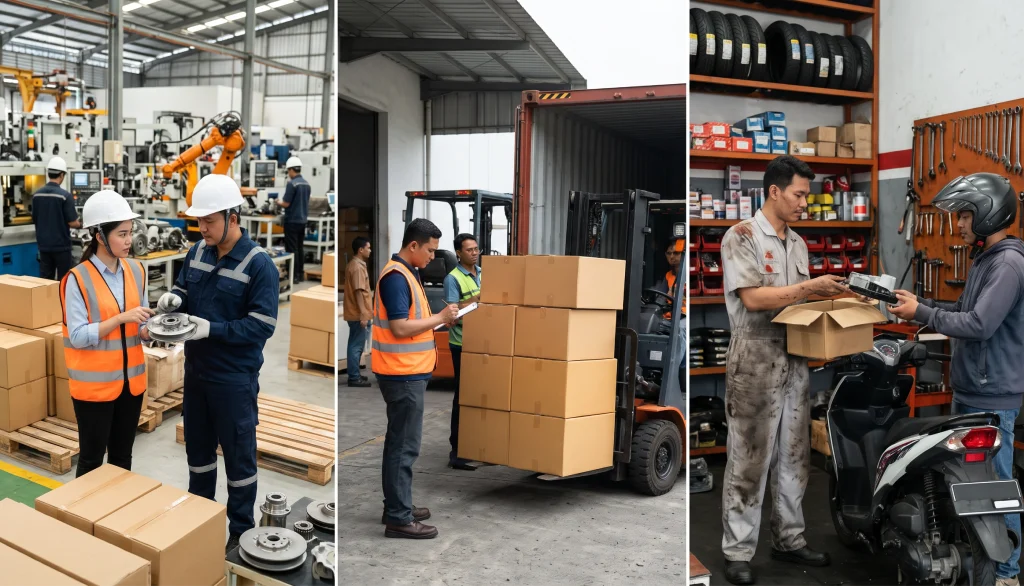
Contract manufacturing is a business arrangement in which product manufacturing is entrusted to a manufacturing company. Meanwhile, the supply chain encompasses a series of activities involving procurement, production, inventory management, distribution, and the delivery of products to customers.
The two are connected because manufacturing is one part of the supply chain. In the automotive spare-parts business, the process may involve product owners, manufacturing partners, suppliers, distributors, spare-part retailers, workshops, and end customers.
When responsibilities are clearly defined between a company and its manufacturing partner, coordination throughout the process can be more structured.
The Role of Contract Manufacturing in the Spare-Parts Supply Chain
1. Supporting Spare-Part Production Management
Companies can outsource the production of specific spare parts to manufacturing partners with processes and facilities suited to their requirements.
Automotive spare-part manufacturing may involve various activities, such as plastic injection molding, CNC turning and milling, Plastic and Metal Quality Assurance and Quality Control (QA/QC), and injection molding machine maintenance, depending on the production requirements and type of product.
With this division of responsibilities, companies can focus more on other activities, such as marketing, sales, distribution, and customer relationship management.
2. Facilitating Procurement Coordination
Procurement involves sourcing goods and obtaining the materials or resources needed for production. In the spare-parts business, information about product types, purchasing requirements, and production plans needs to be communicated clearly to manufacturing partners.
Effective coordination can help reduce the risk of misunderstandings regarding product requirements and the terms of cooperation.
3. Supporting Spare-Part Inventory Management
Spare-part availability is an important consideration in the automotive supply chain. Distributors, spare-part retailers, and workshops may have different inventory requirements depending on their business activities.
Contract manufacturing does not automatically reduce inventory levels. However, coordination between companies and manufacturing partners can help align production plans with procurement requirements and inventory needs.
4. Creating a More Structured Production Flow
Working with a manufacturing partner can help companies divide activities according to each party’s responsibilities.
In simple terms, the flow can be illustrated as follows:
Company → Manufacturing Partner → Spare Parts → Distribution → Customers
The actual flow may vary depending on the company’s business model. Spare parts may also pass through distributors, dealers, spare-part retailers, workshops, or other channels before reaching end customers.
5. Supporting Business Flexibility
Contract manufacturing provides companies with an alternative way to manage production activities. Internal resources can then be directed toward other areas, such as product development, marketing, sales, distribution, and customer relationship management.
Supply Chain Efficiency Depends on More Than Production
Automotive spare-part supply chain efficiency is also influenced by various other activities. Important factors to consider include:
- Clearly defined spare-part requirements.
- Procurement coordination.
- Inventory management.
- Inspection and Quality Control.
- Distribution coordination.
- Communication between companies and manufacturing partners.
- Evaluation of the business partnership.
Therefore, selecting a contract manufacturing partner involves more than assessing production capabilities. It also requires considering whether the partner’s processes and working arrangements align with business requirements.
Contract Manufacturing in the Automotive Spare-Parts Industry
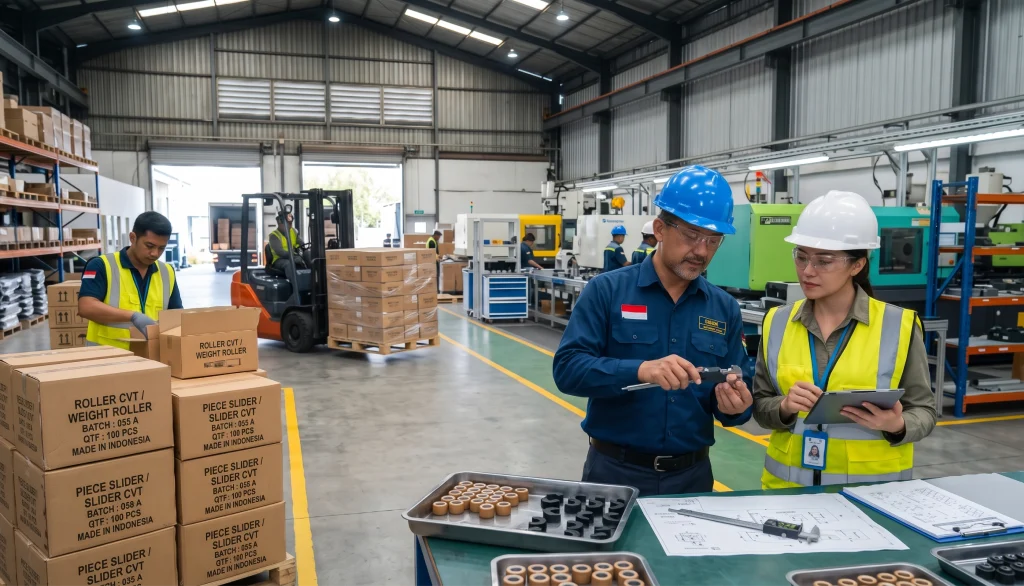
In the automotive industry, contract manufacturing can serve as one model for establishing spare-part production partnerships. PT Sejati Jaya Tangerang is an automotive spare-part manufacturer offering products such as Weight Rollers/CVT Rollers and Piece Sliders/CVT Sliders. Understanding spare-part characteristics and manufacturing processes can help companies evaluate their supply chain collaboration needs more comprehensively.
With clearly defined responsibilities, companies can manage the relationship between business requirements and manufacturing processes more effectively. However, supply chain management still requires planning, communication, quality control, and regular evaluation of the partnership.